Futuristic Sound Healing: Inside Kidus' Black Planetarium
BLACK PLANETARIUM REVIEW
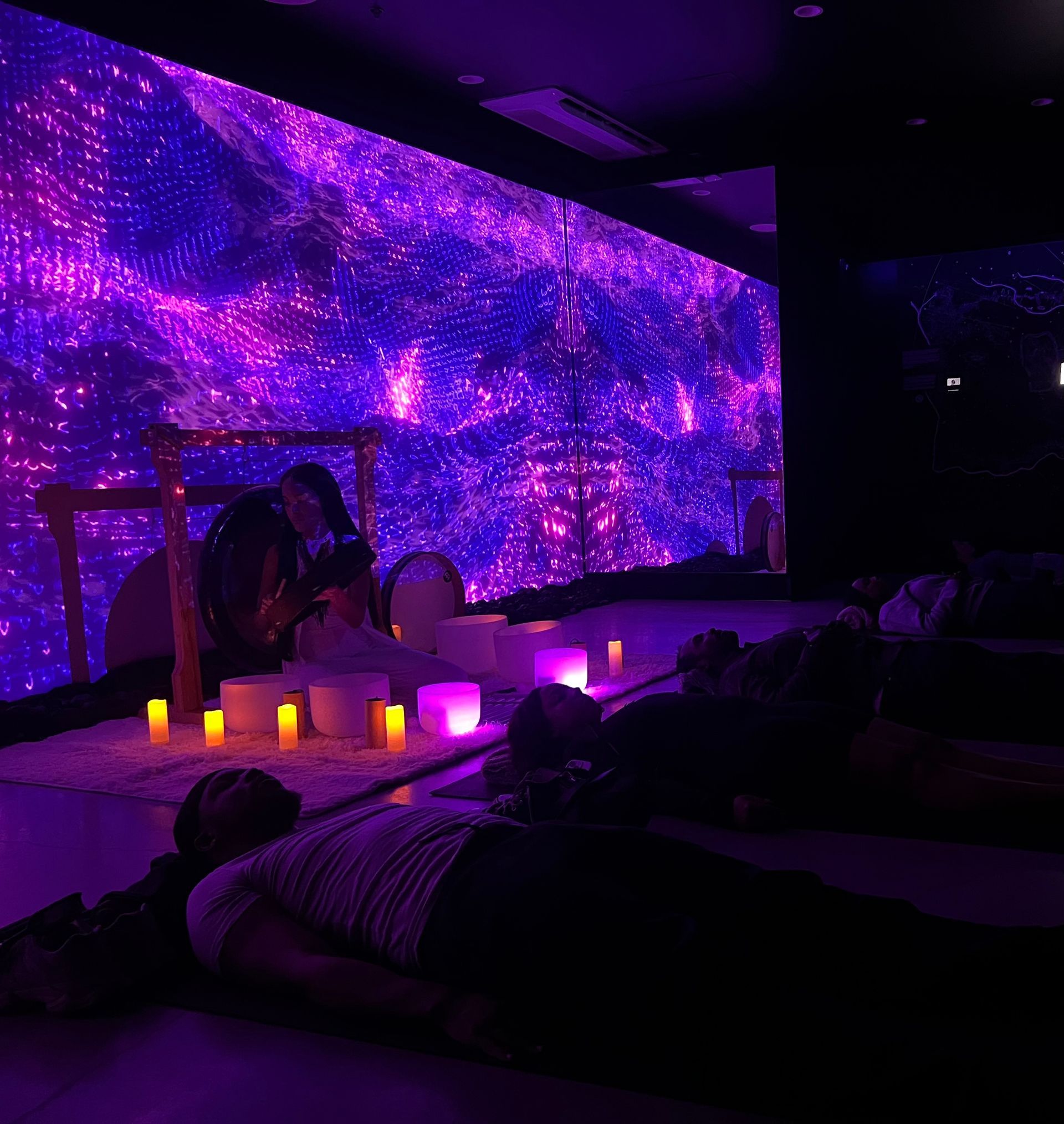
There are moments when art transcends time—when the ancient and the futuristic collapse into a single, shimmering present. This is what happened at The Music Center when I had the honor of facilitating a sound bath within Kidus Hailesilassie's extraordinary Black Planetarium, an immersive experience that redefined what healing and connection can look like in our contemporary moment.
Where Technology Meets Ancestry
Walking into Black Planetarium felt like stepping through a portal. Kidus had constructed a digital cosmos where African coded ocean waves breathed across massive screens, naturally guiding us into a trance like state. The best part was that his body of art didn't stop here. There were multiple entry points into his digital cosmos, with the digital art installation representing just one portal. Some participants experienced a powerful visual of a woman engaging in an meditative dance via VR headsets, while others observed an in-person ancestral dance and monologue, both serving as a direct line of communication with ancestors, a kinetic prayer for guidance and wisdom.
The Sound Bath as Portal
My sound bath emerged as yet another gateway into Kidus's vision, and I felt the weight and gift of that responsibility. As we began with a gentle breathing exercise, accompanied by a buffalo drum, one of the participants later expressed, that the rhythm of our collective breath naturally synced up with the undulation of the digital ocean waves. Once my crystal bowls began singing throughout the space, the concept of time completely dissolved. What struck me most was how naturally the sound healing fit into this futuristic-ancient landscape. Sound healing itself is one of humanity's oldest technologies—used across cultures for millennia—yet here it was, feeling as innovative and forward-thinking as the VR interfaces and coded visuals surrounding us. The singing bowls could have been spacecraft instruments or ceremonial tools from an ancient ritual. In truth, they were both.
Ancient Futures, Future Ancestors
Black Planetarium proved something essential: that our healing doesn't require us to choose between tradition and innovation, between honoring our roots and reaching toward new frontiers. Kidus created a space where African diasporic wisdom could express itself through cutting-edge technology, where VR headsets and tribal dance could coexist without contradiction, where sound healing could be recognized for what it truly is—a timeless practice that belongs to every era, including the ones we haven't yet imagined.
As participants lay on the floor, bathed in sound and surrounded by digital oceans and ancestral presence, something shifted. We weren't just experiencing art or receiving healing—we were participating in a new cosmology, one where our ancestors could guide us through virtual realms and where the future sounds suspiciously like home.
This is the kind of work that reminds me why I do what I do. This sound bath was a deepening into Kidus' vision, a vibrational affirmation that healing has always been, and will always be, our technology of transformation. Whether delivered through gongs or algorithms, dance or digital waves, the invitation remains the same: to remember, to connect, to become whole.
Black Planetarium wasn't just spectacular—it was necessary. It showed us that the path forward might actually be a spiral, carrying us back to ancient wisdoms while launching us toward futures where healing, technology, and ancestral connection aren't separate things at all, but different expressions of the same eternal frequency.